


Ontario immigration with French changed on June 25, 2026, when the province closed its French-Speaking Skilled Worker stream. French still counts: it can meet the language rule of the new Ontario Workforce Priority stream, earn extra points there, and add up to 50 Express Entry CRS points.
Is Ontario's French-Speaking Skilled Worker stream still open?
No, the stream is closed. Ontario's amended nominee program regulation came into force on June 25, 2026, and it removed all 8 existing OINP streams, including the Express Entry French-speaking Skilled Worker stream.
Ontario made the cut clean: no new invitations will go out under the old streams, and registrations still waiting for an invitation were withdrawn automatically. For you, that means French is no longer a stream of its own in Ontario. It's now a scoring bonus inside the new system.
What replaced it: the Ontario Workforce Priority stream
The Ontario Workforce Priority stream is the new OINP route where French counts, and French can meet its language rule. Its expression-of-interest portal opened on August 4, 2026, and the stream usually needs a job offer.
The language minimum depends on the job in your offer, and Ontario accepts the TEF Canada and the TCF Canada for French.
| Job in your offer | Minimum language level (2026) | French tests accepted |
|---|---|---|
| TEER 0-3 | CLB 6 (CLB 5 for certain occupations) | TEF Canada, TCF Canada |
| TEER 4-5 | CLB 4 | TEF Canada, TCF Canada |
You can meet the minimum with French only. Say your English result came back lower than you hoped, but your TCF Canada reaches CLB 6 in every skill: for most TEER 0-3 offers, that French result does the job.
If you'd consider working outside the GTA, look at Ontario's REDI community initiative too. A new round launched in October 2026 and runs to the end of 2027, with partner communities in Sudbury, Kenora, Nipissing, Rainy River, Renfrew and Thunder Bay.
Ontario immigration points for French: the Workforce Priority grid
French earns points in two places on the Workforce Priority grid. Your best official language is scored on its weakest skill, and knowing both English and French gives you 10 points instead of 5.
On that grid, Ontario scores your language results like this in 2026:
- The grid scores your lowest CLB across the four skills: listening, reading, speaking and writing.
- You can use English or French. If you took both tests, the one with the higher CLB counts.
- CLB 9 or higher in your best official language earns 15 points.
- Knowing 2 official languages earns 10 points. One language earns 5.
- For the 10, you need at least CLB 6 in all four skills in both languages.
The last rule is where people lose points without noticing. Say your English is CLB 8 in every skill, and your TEF Canada gives you CLB 6 in listening, reading and writing but CLB 5 in speaking. You get 5 points for languages, not 10, because one French skill sits under CLB 6.
Other factors boost your score too. Since October 5, 2026, if you earned $80,000 or more in a single year during the past 5 years, Ontario gives you 10 points for earnings history.
Toronto, Ottawa or Hamilton: how regional points change your score
Where your job is can move your Workforce Priority score as much as your French. In 2026, Ontario's grid gives 10 regional points to Eastern Ontario, which includes Ottawa, and 10 to Southwestern Ontario, which includes Hamilton. Toronto gets 0.
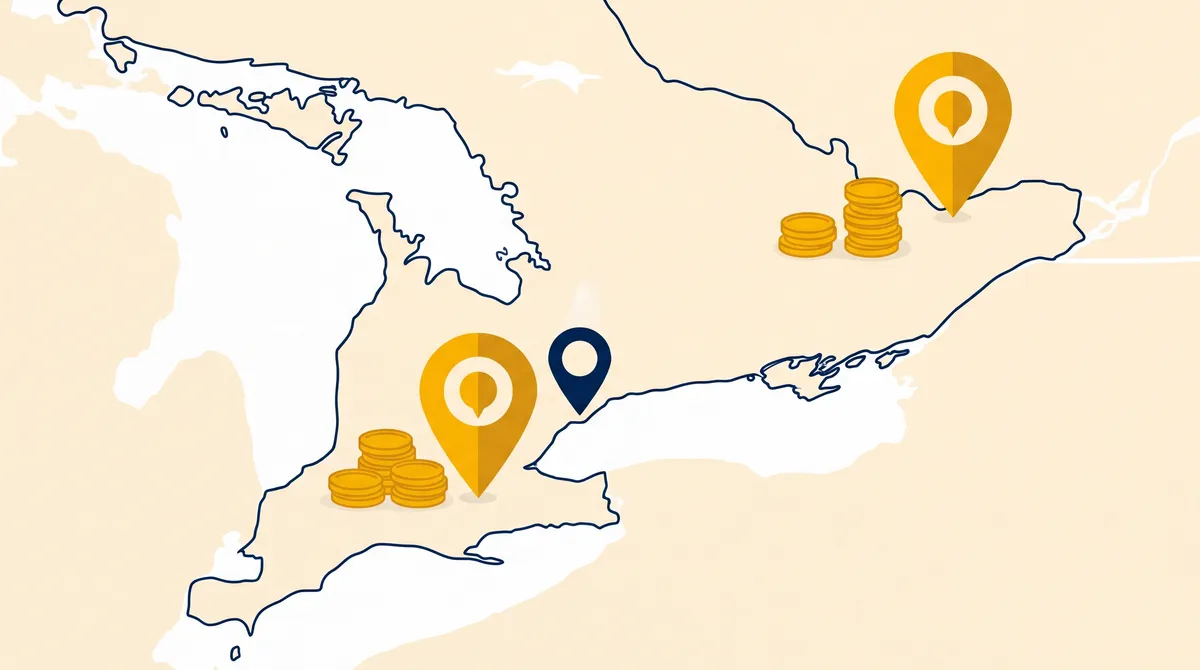
| Where the job is | Regional points (2026) |
|---|---|
| Ottawa (Eastern Ontario) | 10 |
| Hamilton (Southwestern Ontario) | 10 |
| GTA, outside the City of Toronto | 5 |
| City of Toronto | 0 |
Put both factors together and the gap gets wide. The table below adds only the language points and the regional points. The full grid scores other factors as well.
| Job location | English only (5) | English and French at CLB 6+ (10) |
|---|---|---|
| City of Toronto | 5 | 10 |
| GTA, outside Toronto | 10 | 15 |
| Hamilton | 15 | 20 |
| Ottawa | 15 | 20 |
On these two lines, a bilingual candidate with an Ottawa or Hamilton offer scores twice what the same person scores with a Toronto offer. You cannot always choose where your job offer comes from, but if you have options in both cities, knowing how the map changes your points helps you decide.
French beyond the OINP: Express Entry and francophone Ontario
French still counts at the federal level, whatever Ontario does with its own streams. IRCC's CRS criteria give 50 extra points for NCLC 7 or higher in all four French skills when your English is CLB 5 or higher, and 25 when your English is CLB 4 or lower.

Those points apply to every Express Entry candidate, in Ontario or anywhere else. You'll find how the 25 and the 50 are decided in how to get 50 Express Entry points with French.
Hamilton: a Welcoming Francophone Community
IRCC lists Hamilton as one of its Welcoming Francophone Communities, so French-speaking newcomers there get settlement services in French. Hamilton is also a designated area under Ontario's French Language Services Act, which means you can get provincial government services in French.
Learners in the city can join our French classes for Hamilton, held live online.
Ottawa and the Toronto area
Ottawa is fully designated too, along with Toronto, Mississauga, Brampton and Markham. With more than 652,540 Francophones in Ontario, you can deal with provincial offices and public services in French in all of these cities.
In the capital, our French classes for Ottawa run online, in the evening.
Where to take the TEF Canada or TCF Canada in Ontario
Toronto, Ottawa and Hamilton each have a TEF Canada centre, and the TCF Canada is given in the Toronto area and in Ottawa. Most centres charge $390 or $400 in 2026, though a few do not list prices online.
| City | Centre and address | Exams | Fee (2026) |
|---|---|---|---|
| Toronto area | Alliance Française de Toronto: Downtown (24 Spadina Road), North York (47 Sheppard Avenue East, Unit 502), Mississauga (4261 Sherwoodtowne Blvd), Oakville (247 North Service Road West, #303) | TEF Canada, TCF Canada | TEF Canada $390, TCF Canada $390 |
| Ottawa | Alliance Française Ottawa, 352 MacLaren Street | TEF Canada, TCF Canada | TEF Canada $390, TCF Canada $400 |
| Hamilton | Collège Boréal (Hamilton), 120 King Street West, Plaza Level | TEF Canada | Not published |
Each centre books in its own way:
- Alliance Française de Toronto runs sessions every quarter. Registration opens one month before, online only, with no waiting list and no refund. A transfer costs $100.
- Alliance Française Ottawa offers the TCF Canada on a computer or on paper, while the TEF Canada is computer-based only. Neither test can be taken online.
- Collège Boréal doesn't publish its Hamilton fees. The exam owner's centre finder lists its dates.
- For the TCF Canada, Hamilton candidates can use the Alliance Française de Toronto rooms in Oakville or Mississauga.
Most GTA candidates study around a full-time job. Our French classes for Toronto meet live online, twice a week, in the evening.
How your TEF or TCF score becomes a CLB level for Ontario
Ontario reads your French in CLB levels, not in raw scores. Each of your four TEF Canada or TCF Canada scores converts to a CLB level, and the Workforce Priority grid then uses the lowest one.
So a strong listening score can't make up for weak speaking. The TEF scores behind each level are in our TEF Canada CLB conversion guide.
When one skill lags, more passive listening won't fix it. Speaking and writing usually move slower than listening and reading, so it's common to sit at CLB 7 in reading and CLB 5 in speaking.
For speaking, pick one TEF Section B prompt every evening, record your answer on your phone, and listen back only for your verbs. Spotting your own repeated slips in the passé composé does far more for your score than memorizing ten fancy adjectives you will freeze trying to use.
How we help Ontario candidates reach CLB 6 or NCLC 7
Which class you need comes down to where your French sits right now and what score Ontario or Ottawa asks you for. We have taught more than 4,500 students since 2017, many of them people juggling evening study with full-time jobs.
- Zero French, aiming for NCLC 7 in Express Entry: TEF Beginner, 12 months (6 months of Levels 1-6, then 6 months of exam preparation).
- Zero French, aiming for CLB 4 or CLB 5: French Transformation. CLB 5 takes 6 to 9 months from zero.
- B1 or above, with a test date in sight: TEF/TCF exam preparation for B1+ learners. The 3-month plan targets CLB 5 and the 6-month plan targets CLB 7.
- Not sure where you stand: Ontario's CLB 6 sits between those targets, so the free level test below is the place to start.
In our classes, you meet twice a week for 90 minutes, live, with at most 14 students, so everyone speaks in every class. Classes aren't recorded, because the class time is for speaking.
Your teacher corrects your homework, and the exam course works through mock exams for every section. Every plan also includes a year of our online platform, so a missed class has a self-study lesson on the same material.
"I began with the goal of achieving B-level proficiency in French, focusing on grammar and speaking confidence. Over six months, the program intensively covered verb conjugations, liaison, and real-world dialogue practice. Now, I’ve gained confidence in speaking and am comfortable with complex structures. Overall, the program and the instructor; Martha are what I hoped for."