

TEF Canada score requirements can feel confusing. There are different sections, different scales, and a conversion system that looks nothing like other exams. If you’re preparing for Canadian permanent residency through Express Entry, PNP, or citizenship, you need to know your target scores. Knowing how they translate to CLB levels can save you months of wasted preparation.
The good news? Once you understand the scoring system, it’s surprisingly straightforward. And with the right preparation, these targets are achievable. Our 4,500+ students across Canada are proof of that.
Let’s break down every number you need to know.
How Is the TEF Canada Scored?
The TEF Canada evaluates four language skills, and each one uses a different scoring scale. This confuses most people at first. It’s not like IELTS, where everything is scored out of 9.0.
Here’s the breakdown:
- Listening (Compréhension Orale): scored 0 to 699, 40 minutes, multiple choice
- Reading (Compréhension Écrite): scored 0 to 699, 60 minutes, multiple choice
- Speaking (Expression Orale): scored 0 to 699, 15 minutes, face-to-face interview
- Writing (Expression Écrite): scored 0 to 699, 60 minutes, 2 written tasks
Each section is scored independently. There is no overall “total” TEF score for immigration purposes. IRCC evaluates each section separately against CLB thresholds. That means you can’t make up for a weak section by scoring higher in another one.
This is a critical point: you must meet the minimum in every single section.
What CLB Level Do You Need?
The Canadian Language Benchmark (CLB) level you need depends on which immigration program you’re applying through. Most people assume they need CLB 7, but your actual requirement might be higher or lower.
CLB Requirements by Immigration Program
- Express Entry (Federal Skilled Worker): Minimum CLB 7 in all four skills for French as first official language
- Express Entry (Canadian Experience Class): CLB 7 for NOC 0/A jobs, CLB 5 for NOC B jobs
- Provincial Nominee Programs (PNP): Varies by province, typically CLB 4 to CLB 7
- Atlantic Immigration Program: CLB 5 minimum (NOC 0/A/B), CLB 4 (NOC C/D)
- Canadian Citizenship: CLB 4 in speaking and listening only
- Quebec (regular programs): Uses its own scale (B2 on the Échelle québécoise). TEF/TCF scores still apply.
For Express Entry, CLB 7 is the benchmark most candidates target. It’s the minimum for the Federal Skilled Worker program. It’s also the threshold where you earn maximum CRS points for French as a second language.

TEF Canada to CLB Conversion Chart (2026)
This is the official conversion table used by IRCC. Bookmark it. You’ll use it throughout your preparation.
The TEF Canada requires a minimum score of 434/699 in Reading, 428/699 in Writing, 434/699 in Listening, and 456/699 in Speaking to achieve CLB 7.
| CLB Level | Reading (CE) | Writing (EÉ) | Listening (CO) | Speaking (EO) |
|---|---|---|---|---|
| CLB 10 | 546–699 | 558–699 | 546–699 | 556–699 |
| CLB 9 | 503–545 | 512–557 | 503–545 | 518–555 |
| CLB 8 | 462–502 | 472–511 | 462–502 | 494–517 |
| CLB 7 | 434–461 | 428–471 | 434–461 | 456–493 |
| CLB 6 | 393–433 | 379–427 | 393–433 | 422–455 |
| CLB 5 | 352–392 | 330–378 | 352–392 | 387–421 |
| CLB 4 | 306–351 | 268–329 | 306–351 | 328–386 |
Notice that Speaking (EO) has the highest threshold at CLB 7. You need 456 out of 699. That’s roughly 65% of the total scale. Many students find this is their most challenging section. Dedicated speaking practice with native teachers makes a big difference here.
TCF Canada to CLB Conversion Chart
Taking the TCF Canada instead? The scoring system is different. The TCF uses a scale out of 699 for comprehension sections, and a scale out of 20 for production sections (Speaking and Writing).
Many students don’t realize the TCF Writing and Speaking sections are scored out of 20, not 699. This catches people off guard on test day.
| CLB Level | Reading (CE) | Writing (EÉ) | Listening (CO) | Speaking (EO) |
|---|---|---|---|---|
| CLB 10 | 549–699 | 16–20 | 549–699 | 16–20 |
| CLB 9 | 524–548 | 14–15 | 523–548 | 14–15 |
| CLB 8 | 499–523 | 12–13 | 503–522 | 12–13 |
| CLB 7 | 453–498 | 10–11 | 458–502 | 10–11 |
| CLB 6 | 406–452 | 7–9 | 398–457 | 7–9 |
| CLB 5 | 375–405 | 6 | 369–397 | 6 |
| CLB 4 | 342–374 | 4–5 | 331–368 | 4–5 |
For TCF Canada CLB 7, you need: 453+ in Reading, 10+ in Writing, 458+ in Listening, and 10+ in Speaking. The Writing and Speaking thresholds of 10/20 (50%) may sound easier, but these sections are examiner-graded and standards are strict.
How Do TEF Scores Compare to IELTS?
If you’ve already taken IELTS for English, this comparison will help you understand what CLB 7 means in practice. CLB 7 in French is equivalent to IELTS 6.0 in English. That’s the same threshold most Express Entry applicants need for their English scores.
IELTS vs TEF: CLB Equivalence
- CLB 4 = IELTS 4.0 to 4.5 = TEF 268 to 351 per section → Basic conversational level
- CLB 5 = IELTS 5.0 = TEF 330 to 392 per section → Functional in daily situations
- CLB 7 = IELTS 6.0 = TEF 428 to 461 per section → Express Entry minimum
- CLB 9 = IELTS 7.0 = TEF 503 to 557 per section → Maximum CRS bonus points
What most people don’t realize is that you don’t need to be fluent to reach CLB 7. It’s a solid intermediate level. You can hold conversations, understand news articles, write structured texts, and follow lectures. Most learners starting from zero reach it in 8 to 12 months of consistent study.

How Many CRS Points Can French Give You?
French proficiency can add up to 50 additional CRS points to your Express Entry profile. That can be the difference between getting an Invitation to Apply (ITA) and waiting for months.
According to IRCC’s official language requirements, candidates who show proficiency in both official languages receive additional CRS points. French is by far the fastest second language to add to your profile if you already have strong English.
CRS Points for French (Second Language)
- CLB 7 in all 4 skills + CLB 5+ in English: 25 bonus points
- CLB 7 in all 4 skills + CLB 7+ in English: 50 bonus points
- CLB 5 to 6 in all 4 skills: Limited points (varies by English level)
The sweet spot is CLB 7 in French combined with strong English scores. If you already have IELTS 6.0+ (CLB 7 in English), adding French CLB 7 earns you the full 50 CRS points. For context, that’s more than a Master’s degree (30 points) or 3 years of Canadian work experience (40 points).
We’ve written a detailed breakdown of exactly how these points work in our Express Entry Points for French guide.
Which Section Is the Hardest to Score CLB 7?
Based on our experience with 4,500+ students, here’s an honest breakdown of which TEF sections students find most challenging, and what it actually takes to hit CLB 7 in each one.
Speaking (Expression Orale): The Most Feared
CLB 7 target: 456/699. This is a live, face-to-face interview with a French examiner. You’ll answer questions about personal topics (Section A) and debate a given topic (Section B). Most students are nervous, but the secret is structure. The examiners use a rubric, and if you know what they’re scoring, you can prepare strategically.
Our TEF Prep program includes dedicated mock interviews scored by native French teachers who know exactly what examiners look for. For a detailed guide on what to expect, check our TEF vs TCF comparison to see which exam’s speaking format suits you better.
Writing (Expression Écrite): The Most Technical
CLB 7 target: 428/699. You’ll write two pieces: a short report/summary and an argumentative essay. Grammar, structure, and vocabulary range all matter. The good news? Writing is the most improvable skill. It responds directly to practice and feedback.
What separates CLB 6 from CLB 7 in Writing is usually connectors and structure. Students who use transition phrases (cependant, par conséquent, d’une part… d’autre part) and organize their essays with a clear introduction-body-conclusion format consistently score higher. Complex grammar matters less than organized thinking in French.
Listening (Compréhension Orale): The Fastest to Improve
CLB 7 target: 434/699. Multiple-choice questions based on audio recordings. The exam plays recordings of conversations, announcements, and news reports. You listen once and answer. Students who immerse themselves in French podcasts, Radio-Canada news, and French YouTube channels for 30 minutes daily see rapid improvement. This is often the fastest section to improve.
The key to the Listening section? Don’t try to understand every word. Focus on the question before the audio plays, listen for the specific information asked, and eliminate obviously wrong answers. Most wrong answers are traps. They use words you heard, but in a different context.
Reading (Compréhension Écrite): The Most Predictable
CLB 7 target: 434/699. Multiple-choice questions on written passages. Reading is often the highest-scoring section because the answers are right in front of you. With practice on exam-style texts, such as newspaper articles, advertisements, formal letters, and informational documents, most students reach CLB 7 in Reading first.
The strategy that works best? Read the questions before the text. This way you know exactly what to look for, and you won’t waste time on irrelevant details. Time management is critical. You have 60 minutes for 50 questions, roughly 1 minute per question.
How We Help Students Hit Their Target Scores
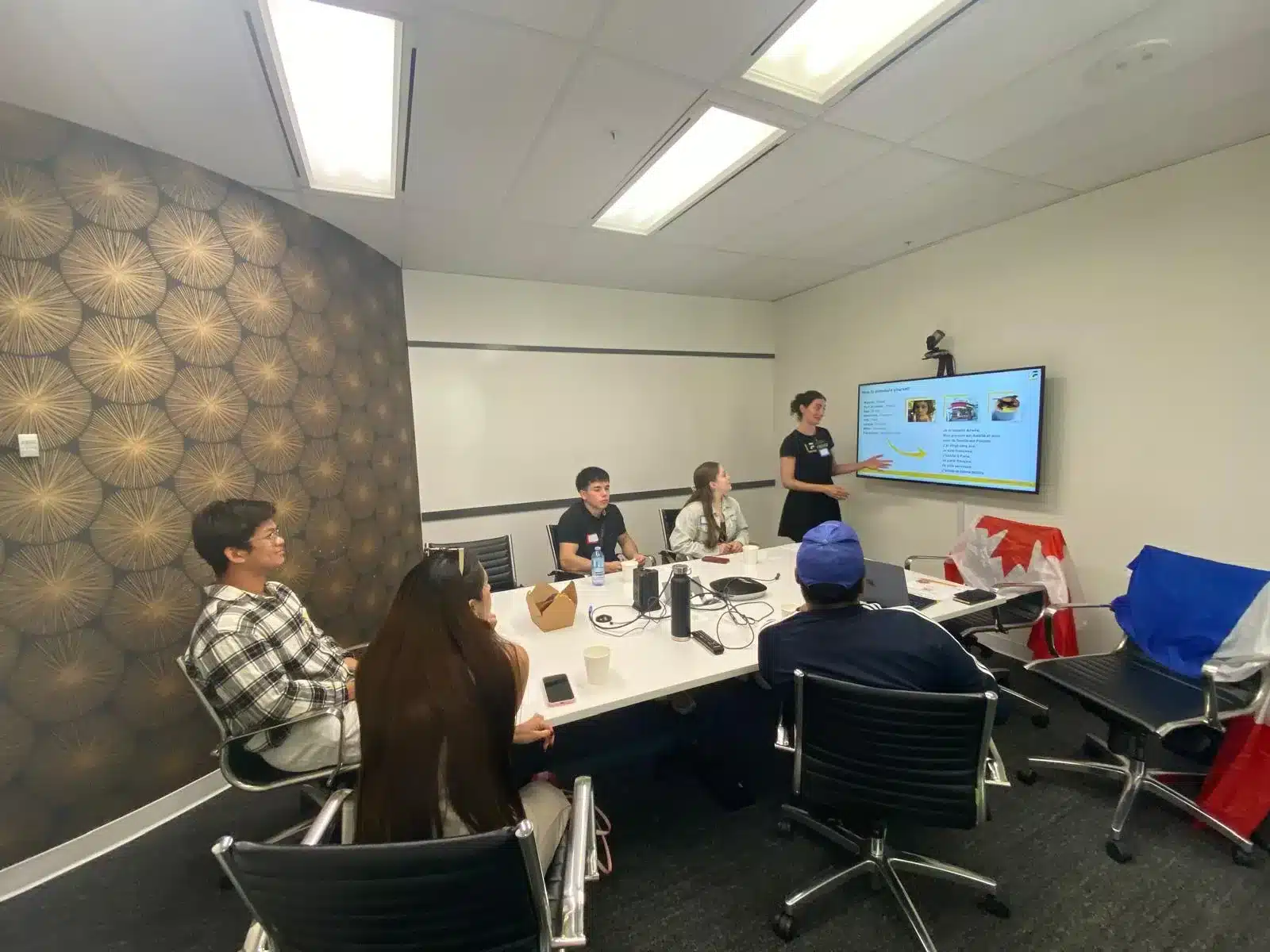
At Learn French Canada, teaching French is only part of what we do. We prepare students specifically for the scores they need. Every program is designed around the CLB system, with mock exams that mirror real TEF and TCF conditions.
Starting from Zero? The TEF for Beginners Program
Our 12-month TEF for Beginners program takes you from absolute zero to CLB 7 exam-ready. The first 6 months build your French foundations (Levels 1 to 6). The final 6 months are 100% exam-focused: all four TEF/TCF sections, mock exams, and teacher feedback on every practice test.
Two classes per week, 90 minutes each, with native French teachers from France and Quebec. Online via Zoom from anywhere in Canada.
Already Have Some French? TEF/TCF Prep
If you’re already at an intermediate level (B1+), our 3 or 6-month TEF/TCF Prep program focuses exclusively on exam strategy. Every class targets specific CLB thresholds. We don’t waste time on content that won’t appear on your exam.
“I was nervous about the writing and speaking sections, but the mock exams gave me so much confidence. I got CLB 7 on my first try!” — Denise, Vancouver
TEF Score Validity: How Long Do Results Last?
TEF Canada results are valid for 2 years from the test date. This is an IRCC requirement. If your results expire before you submit your PR application, you’ll need to retake the exam.
This means timing matters. The honest answer? Most students should plan to take the exam 6 to 12 months before their target application date. That’s early enough to retake if needed, but not so early that results expire.
TCF Canada results follow the same 2-year validity rule. Neither exam offers partial retakes. If you want to improve one section, you must retake the entire exam. You can find the official guidelines on the TEF Canada official website.
Quick Validity Timeline
- Test date: The clock starts here
- Results available: TEF = ~3 weeks after test date / TCF = ~4 weeks
- Valid for PR application: 2 years from test date (not results date)
- Pro tip: Take the exam when you’re ready, not when you “think” you’re ready. An extra month of preparation is cheaper than retaking the exam.
Frequently Asked Questions
What is the minimum TEF score for CLB 7?
Is the TEF or TCF easier to score CLB 7?
Can I get Express Entry points with CLB 5 in French?
How long does it take to go from zero French to CLB 7?
Do TEF scores expire?
What if I only pass CLB 7 in 3 out of 4 sections?
Ready to start working toward your target CLB score? Whether you’re starting from zero or already have some French, we have a program built around the exact scores you need. Text or WhatsApp us at +1-778-800-5592 to discuss your timeline, or visit our TEF preparation programs to find the right fit.
Your Next Step: Know Your Starting Point
Now that you understand exactly what scores you need, the question is: where are you right now? Knowing your current level is the first step to building a realistic preparation timeline.
If you’re starting from zero, plan for 10 to 12 months to reach CLB 7. If you already have some French (even from high school or a romance language background), you might be closer than you think. Many of our students test at CLB 4 to 5 before they even start formal preparation. They often need only 3 to 6 months of focused exam prep.
The worst mistake you can make is waiting. TEF scores are valid for 2 years, so there’s no downside to starting preparation early. Every month you delay is a month further from your PR timeline.
Text or WhatsApp us at +1-778-800-5592 to discuss your timeline and find the right program, or read our guide on how long it takes to learn French for Canadian PR for detailed timelines by starting level.
Rated 5.0 stars across 300+ Google reviews, by the Learn French Canada team.