
Self-study French in Canada is one of the most searched topics among immigration candidates, and for good reason. Not everyone can commit to a fixed class schedule, and with the right structure, self-study can get you to CLB 5 or even CLB 7 on the TEF or TCF. But there’s a catch most blog posts don’t mention: the majority of self-study learners quit within the first 3 months.
Most people approach self-study without a plan. They jump between apps, watch random YouTube videos, and never actually practise the skills the TEF and TCF test. At Learn French Canada, we’ve trained 4,500+ students across the country, rated 5.0 stars across 300+ Google reviews. Some of our most successful students started with self-study before moving to structured prep. This guide gives you the framework that separates the students who pass from the ones who give up.
Is Self-Study French Actually Effective for Canadian Immigration?
Let’s start with the honest answer: self-study French works for some people, but it’s significantly harder than most apps and YouTube channels suggest. The data from our 4,500+ students tells a clear story:
- A1 level (basic greetings, simple phrases): achievable through self-study alone in 2 to 3 months. Apps like Duolingo and Babbel are genuinely useful at this stage.
- A2 level (simple conversations, basic writing): still possible through self-study, but progress slows significantly around month 3 to 4. This is where most self-learners plateau.
- B1 level / CLB 5 (functional independence): achievable through self-study, but only with highly disciplined daily practice and structured materials. Expect 6 to 9 months.
- B2 level / CLB 7 (exam-ready for Express Entry): very few students reach this level through pure self-study. The speaking and writing sections of the TEF/TCF require feedback from a real person to reach CLB 7 consistently.
The key insight: self-study is excellent for building foundations (A1 to B1) but struggles to develop the productive skills (speaking and writing) that TEF/TCF examiners evaluate at CLB 7. The most effective approach is a hybrid: self-study for the first 4 to 6 months, then professional preparation for exam readiness.
When Does Self-Study Make More Sense Than Classes?
Self-study and group classes aren’t competing options. They serve different purposes. Here’s when each approach makes the most sense:
| Choose Self-Study If… | Choose Classes If… |
|---|---|
| Your schedule is unpredictable (shift work, travel) | You can commit to 2 fixed sessions per week |
| You’re highly self-disciplined with a study habit | You need external accountability to stay consistent |
| Budget is very tight (under $400) | You can invest $400/month for structured progress |
| You’re targeting CLB 5 (not CLB 7) | You need CLB 7 for Express Entry maximum points |
| You’re starting from scratch and want to build basics first | You already have basics and need exam-specific prep |
| Your exam is 8+ months away | Your exam is 3–6 months away and you need results fast |
The smartest candidates do both. They self-study for the first few months to build a solid foundation, then switch to a structured program when they need speaking practice, writing feedback, and exam strategy. You don’t have to choose one path from day one.
What Does an Effective Weekly Self-Study Schedule Look Like?
The #1 reason self-study fails is not lack of motivation. It’s lack of structure. Without a class schedule forcing you to show up twice a week, you need to build that structure yourself. Here’s the weekly framework that actually works:
The 5-Hour Weekly Self-Study Plan
| Day | Activity (45 min) | Skill Trained |
|---|---|---|
| Monday | New grammar lesson + exercises | Reading, Writing |
| Tuesday | Listening practice (podcast/news + comprehension questions) | Listening |
| Wednesday | Vocabulary review (flashcards) + reading exercise | Reading, Vocabulary |
| Thursday | Writing practice (journal entry or essay) | Writing |
| Friday | Speaking practice (record yourself, repeat dialogues) | Speaking |
| Weekend | French media immersion (movie, YouTube, podcast, done for enjoyment) | Listening, Culture |
The golden rule: every single day should include at least 15 minutes of French. Even on rest days. Consistency beats intensity. A student who studies 20 minutes daily will outperform one who crams 3 hours on weekends. Your brain needs daily exposure to build the neural pathways that make French feel natural rather than translated.
What Should You Study Each Month? A 6-Month Self-Study Roadmap
One of the biggest problems with self-study is not knowing what to learn next. Here’s a month-by-month roadmap from zero to exam-ready:
Month 1 to 2: Foundations (A1 Level)
- Grammar: Present tense of être, avoir, aller, faire + regular -er verbs. Articles (le, la, les, un, une, des). Basic negation (ne…pas).
- Vocabulary: 500 most common French words. Focus on: introductions, numbers, time, daily routines, food, directions.
- Listening: Start with slow, clear French, like Coffee Break French podcast or Français avec Pierre on YouTube.
- Speaking: Practise basic self-introduction, ordering food, asking directions. Record yourself and compare to native audio.
- Milestone: You can introduce yourself, ask basic questions, and understand simple spoken French at slow speed.
Month 3 to 4: Building Confidence (A2 Level)
- Grammar: Past tense (passé composé), future tense, direct/indirect object pronouns, comparative/superlative.
- Vocabulary: Expand to 1,200+ words. Add: travel, work, health, opinions, describing people and places.
- Listening: Move to normal-speed content, like France 24 news summaries or Journal en français facile (RFI).
- Writing: Start writing short paragraphs (5 to 8 sentences) about daily topics. Keep a French journal.
- Milestone: You can hold short conversations about familiar topics, write simple messages, and understand the main idea of clear standard speech.
This is where most self-study learners hit the A2 plateau, the point where basic communication feels manageable but real progress stalls. If you’re stuck here for more than 4 weeks, it’s a sign you need external input (a teacher, a language partner, or structured materials).
Month 5 to 6: Exam Preparation (B1 → B2)
- Grammar: Subjunctive mood (key triggers only), conditional tense, relative pronouns (qui, que, dont, où), advanced connectors.
- Vocabulary: 2,000+ words. Add: argumentation vocabulary, abstract concepts, formal register for writing.
- Exam-specific practice: This is where self-study alone gets difficult. TEF/TCF practice tests, timed reading exercises, listening under exam conditions.
- Speaking: You must practise with another person at this stage. Self-recording is no longer sufficient for CLB 7. Find a language exchange partner, tutor, or structured prep course.
- Milestone: You can express opinions, argue a position, understand native-speed media, and write structured essays with connectors.
For detailed timelines and what each CLB level means for your immigration goals, see our guide to how long it takes to learn French for Canadian PR.
Which Free and Paid Resources Are Actually Worth Your Time?
The internet is flooded with French learning resources, and most of them will waste your time. Here’s an honest breakdown of what works, what doesn’t, and where to invest your money:
Free Resources That Actually Work
- Duolingo: Good for absolute beginners (first 2 to 3 months). Builds basic vocabulary and sentence patterns. Completely useless for TEF/TCF preparation beyond A1.
- Journal en français facile (RFI): Daily 10-minute news podcast in simplified French. Best free listening practice available. Start at month 2 to 3.
- Français avec Pierre (YouTube): Clear explanations of grammar concepts with native pronunciation. Good complement to any textbook.
- Anki flashcards: Spaced repetition system for vocabulary. Create your own cards from words you encounter in context. Don’t download random pre-made decks.
- TV5Monde: Free exercises, videos, and cultural content at every level. The Apprendre le français section is underrated.
Resources That Sound Good But Don’t Prepare You for TEF/TCF
- Netflix with French subtitles: Enjoyable but passive. You’re reading, not listening. Use French audio with French subtitles instead, or no subtitles at all.
- Generic grammar textbooks: They teach French in general, not French for the TEF/TCF. You’ll study topics the exam never tests while missing format-specific skills.
- Language exchange apps (Tandem, HelloTalk): Great for casual practice, unreliable for structured improvement. Your exchange partner isn’t a teacher and can’t evaluate your CLB level.
Paid Resources Worth the Investment
- A structured self-study course designed for TEF/TCF: This is the single best investment for self-learners. A course built around the actual exam format gives you the right content in the right order, with practice tests that match what you’ll face on exam day.
- Official TEF/TCF practice materials: Available from CCI Paris (TEF) and France Éducation International (TCF). Expensive but closest to the real exam.
- A few private tutoring sessions: Even 5 to 10 hours of one-on-one tutoring can transform your speaking and writing. Worth it in the final 4 to 6 weeks before your exam.
Why Do Most Self-Study Learners Quit, and How Do You Avoid It?
This is the section nobody else writes about, but it’s the most important one. Studies show that over 90% of people who start learning a language through apps abandon it within 3 months. Understanding why helps you beat the odds.
The 4 Self-Study Traps (and How to Escape Each One)
- The “App Hopping” trap: Downloading 5 apps, using each for a week, feeling like you’re learning but never progressing beyond Bonjour, je m’appelle…Fix: Choose ONE primary resource and stick with it for at least 8 weeks before evaluating.
- The “Passive Input” trap: Listening to French podcasts and watching French Netflix for months without ever speaking or writing. You feel immersed but can’t produce a sentence. Fix: For every hour of input (listening/reading), do 30 minutes of output (speaking/writing).
- The “Perfectionism” trap: Refusing to move forward until you’ve perfectly memorized every conjugation table. Fix: Aim for 70% accuracy, not 100%. You’ll naturally correct errors as you progress. Stalling at A1 grammar while avoiding A2 content is the worst outcome.
- The “No Deadline” trap: Studying “when you feel like it” with no exam date booked. Fix: Book your TEF/TCF exam date NOW, even if it’s 8 to 12 months away. Having a fixed deadline transforms casual study into purposeful preparation.
Pro tip: Track your study time in a simple spreadsheet or notebook. Students who log their hours consistently study 40% more than those who don’t, because skipping a day becomes visible instead of invisible.
For a deeper understanding of what CLB 7 actually requires and whether your self-study progress is on track, read our complete guide to reaching CLB 7 in French.
When Is It Time to Add Professional Help to Your Self-Study?
Self-study gets you far. But there are clear signs you’ve gotten most of the value from studying alone. At some point, you need a teacher to break through to the next level:
- You’ve been stuck at the same level for 4+ weeks: the A2 plateau is real, and more self-study won’t fix it if the problem is speaking or writing quality
- You can read French but can’t speak it: this is the most common self-study gap, because you never have to produce language when studying alone
- Your exam is less than 3 months away: exam-specific strategy (time management, section tactics, mock tests) is nearly impossible to develop without expert guidance
- You don’t know what you don’t know: a teacher can diagnose grammar gaps, pronunciation habits, and exam weaknesses in a single session that would take months to discover alone
“I tried self-study for 5 months and made good progress, but I couldn’t get past the speaking barrier. After joining the group classes, I went from struggling to hold a conversation to passing TEF with CLB 7 in all sections in just 4 months. I wish I’d combined both from the start.” — Marcus, Calgary (Google Review)

How Does Our Self-Study TEF Course Bridge the Gap?
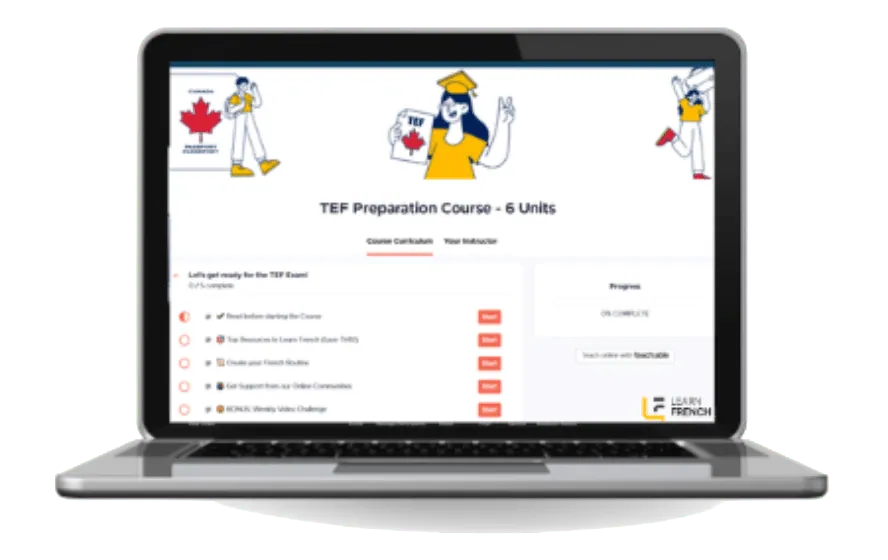
Our Self-Study TEF Course (CA$399) was designed specifically for the self-learner who wants structure without a fixed class schedule. It’s the same curriculum our native French teachers from France and Quebec use in our live programs, adapted for independent study.
What’s Included
- 6 structured units covering all TEF/TCF sections: listening, speaking, reading, writing
- Practice exams that mirror the real TEF/TCF format with answer keys and scoring guides
- Strategy guides for each section, using the same techniques our teachers use with retake students
- Video lessons from our native French teachers explaining key concepts and exam tactics
- Progress checkpoints so you know when you’re on track and when you need more work
What makes it different from free resources: everything is sequenced in the right order for the TEF/TCF, with nothing irrelevant. You’re following a proven path from A1 to exam-ready, not piecing together random lessons.
For students who want live classes instead, our TEF for Beginners program takes you from zero to CLB 7 in 12 months with 2 live classes per week (max 14 students). Many students start with self-study and move to this program at month 4 to 6. Our 4,500+ students have gone on to sit the TEF or TCF after completing our structured programs.
Not sure which exam to target? Our TEF vs TCF comparison guide breaks down the differences to help you choose.