


TEF exam day is one of the most nerve-wracking days in your Canadian immigration process. But it doesn’t have to be. You might be taking the TEF for Express Entry, Provincial Nominee Programs, or citizenship. Knowing what happens from arrival to results turns panic into confidence.
After preparing 4,500+ students for the TEF and TCF across Canada, we’ve heard every question and every worry. This guide walks you through the entire exam day, hour by hour, section by section, so there are zero surprises.
The Week Before: Your Final Preparation Checklist
The work you do in the 7 days before your TEF exam is about logistics and mental preparation, not cramming vocabulary.
Documents and ID
Your passport is the only accepted ID at most TEF test centres in Canada. Not your driver’s licence, not your PR card. Just your passport, and it must match the name you used during registration exactly.
- Valid passport: check the expiry date now, not the morning of
- Registration confirmation email: print it or have it accessible on your phone
- Exact name match: if there’s a discrepancy (hyphenated name, middle name), contact your test centre before exam day
Mental Preparation
The biggest mistake our students report? Studying until 2 AM the night before. Here’s what actually works:
- Stop intensive studying 48 hours before. Light review only
- Do one final TEF practice test 3-4 days before to gauge your readiness
- Sleep 7-8 hours the night before. No exceptions
- Prepare a light, protein-rich breakfast for the morning. You’ll need sustained energy
What to Bring (and What to Leave Home)
| Bring | Leave Home |
|---|---|
| Valid passport | Smartwatch or fitness tracker |
| Registration confirmation | Notes, dictionaries, study materials |
| Water bottle (quiet cap) | Tablets or laptops |
| Quiet snack (granola bar, nuts) | Noisy food or wrappers |
| Light sweater (rooms can be cold) | Bulky bags or backpacks (if possible) |
Pro tip from our teachers: Bring a small analog watch. You won’t have your phone, and not all test rooms have visible clocks.
What Happens When You Arrive at the Test Centre?
Plan to arrive 20-30 minutes before your scheduled time. Latecomers are not allowed in once the test begins. No exceptions, no second chances.

The Check-In Process, Step by Step
Here’s exactly what happens when you arrive at the test centre:
- ID verification: The supervisor checks your passport against your registration
- Information validation: You confirm your personal details on a tablet. Double-check everything: this appears on your certificate
- Signature and photo capture: Both will appear on your official TEF certificate
- Personal belongings stored: Phone completely powered off, all electronics and study materials stored away
- Seating assignment: You’re directed to your workstation with a computer and headset
This check-in process takes 15-20 minutes even when everything goes smoothly. That’s why arriving early isn’t optional.
What Does Each TEF Section Look Like on Exam Day?
The TEF Canada has four mandatory sections, and all four must be completed on the same day for your certificate to be valid for immigration. The computer-based sections (reading, listening, writing) are done back-to-back, with the speaking test scheduled separately. Plan for 3-4 hours total. Most centres run sessions between 9:00 AM and 5:00 PM.
Compréhension Écrite (Reading): 60 Minutes
This is usually the first section. You’ll answer 50 multiple-choice questions on a computer, working through texts of increasing difficulty.
- Format: Multiple choice on computer
- Duration: 60 minutes
- Questions: 50
- What you see: Short texts, articles, advertisements, formal documents
- Scoring: 0-300 points
Exam day reality: The difficulty ramps up significantly in the last 15 questions. Don’t spend too much time on early questions. Budget roughly 1 minute per question and flag anything you’re unsure about to revisit.
What a Real Reading Question Looks Like
Here’s the kind of question you’ll face in the reading section, and why the wrong answers are designed to trap you:
Text excerpt:“La mairie de Lyon a annoncé que les travaux de rénovation du parc seront terminés d’ici la fin du mois de mars. Les résidents pourront à nouveau profiter des nouvelles installations sportives dès le premier avril.”
Question:Quand les résidents pourront-ils utiliser les nouvelles installations?
- A) À la fin du mois de mars
- B) Le premier avril
- C) Pendant les travaux de rénovation
- D) Après l’annonce de la mairie
The trap: Option A is the most common wrong answer here. The text says construction finishes by end of March, but residents can use the facilities starting April 1st. Many students confuse the completion date with the access date. This distinction between two dates in the same sentence is a classic TEF reading trap.
Compréhension Orale (Listening): 40 Minutes
You’ll wear headphones and listen to audio recordings while answering questions on screen. Each recording plays only once. There’s no rewind button.
- Format: Multiple choice with audio on computer
- Duration: 40 minutes
- Questions: 40
- What you hear: Short dialogues, announcements, news reports, lectures
- Scoring: 0-360 points
Critical detail: Before the exam starts, you’ll get a moment to adjust your headset volume. Take this seriously. If the volume feels “fine,” turn it up one more notch. In a room full of typing and chair-shifting, you want audio clarity with zero strain.
Expression Écrite (Writing): 60 Minutes
The writing section has two tasks completed on a computer with a QWERTY keyboard. A virtual keyboard with French special characters (é, è, ê, ç, à) appears on screen. You don’t need to memorize keyboard shortcuts.
- Section A (25 min): Write a short article or report based on given data, 80 words minimum
- Section B (35 min): Express and justify a point of view on a given topic, 200 words minimum
- Scoring: 0-450 points
The word minimums are minimums, not targets. Students who score well typically produce 100-120 words for Section A and 250-300 for Section B. Going slightly above shows language range without wasting time.

Expression Orale (Speaking): 15 Minutes
This is the section that causes the most anxiety. The speaking test is a face-to-face interview with a trained examiner. No computer, no multiple choice. Just you and the examiner in a room.
- Section A (5 min): Obtain information by asking questions. The examiner gives you a scenario (booking a hotel, asking about a service) and you ask relevant questions
- Section B (10 min): Express and defend a point of view. You receive a topic, state your opinion, and defend it while the examiner challenges your arguments
- Scoring: 0-450 points
Example Section A prompt:“Vous appelez une agence de voyages pour organiser un voyage. Posez des questions pour obtenir les informations nécessaires.” (You’re calling a travel agency to plan a trip. Ask questions to get the necessary information.)
What most students don’t expect: The examiner is trained to be neutral. They won’t smile, won’t nod encouragingly, won’t tell you if you’re doing well. This is completely normal. They are scoring your French. Your personality does not affect your score. Don’t let their expression throw you off.
The speaking test is also recorded. You’ll consent at the start. This is standard procedure used for quality control by CCI Paris Île-de-France, the organization that administers the TEF worldwide.
What Scores Do You Actually Need?
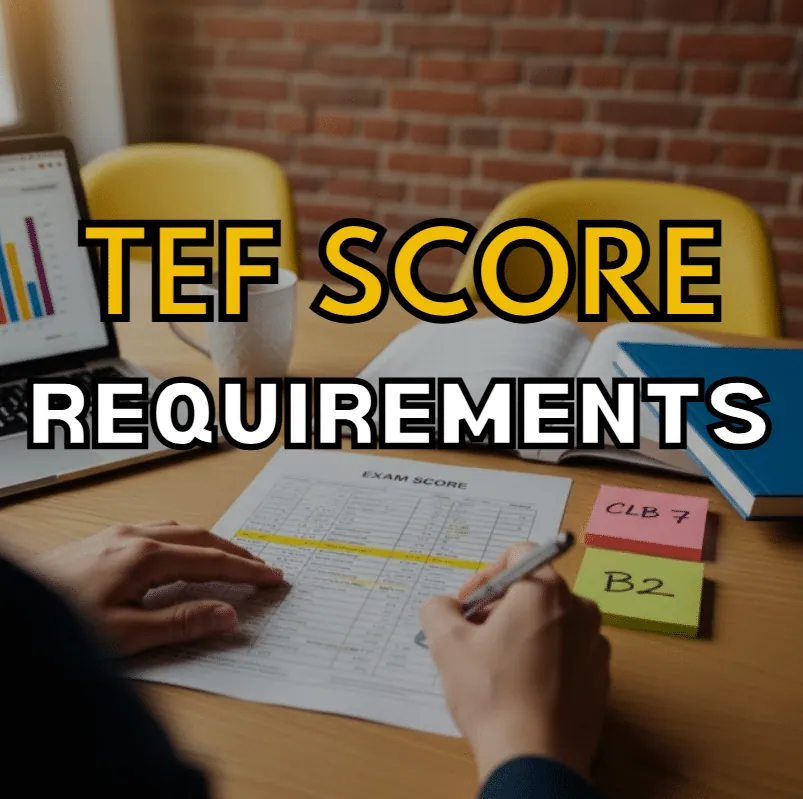
This depends entirely on your immigration pathway. The TEF Canada uses a points system (not pass/fail), and your scores are converted to CLB levels for immigration purposes.
| Immigration Purpose | CLB Required | IELTS Equivalent |
|---|---|---|
| Express Entry (Federal Skilled Worker) | CLB 7 in all 4 sections | IELTS 6.0 |
| Canadian Citizenship | CLB 4 (speaking & listening) | IELTS 4.0-4.5 |
| Provincial Nominee Programs | CLB 4-7 (varies by province) | IELTS 4.0-6.0 |
| Extra CRS Points (bilingual bonus) | CLB 7+ in all 4 sections | IELTS 6.0+ |
The TEF Canada requires a minimum score of 226/450 in each section to achieve CLB 7. For a detailed breakdown of what CLB 7 actually means and how to reach it, see our complete guide to CLB 7 in French.
Not sure whether the TEF or TCF is the better choice for your situation? We break down the key differences in our TEF vs TCF comparison guide.
How Do You Handle Nerves on TEF Exam Day?
Some level of nervousness is completely normal. The stakes are real. But there’s a big difference between productive adrenaline and paralyzing anxiety.
Strategies Our Students Swear By
- Arrive early and settle in. Rushing into the exam room with your heart pounding is the worst way to start. Give yourself 20-30 minutes of calm before the test begins.
- Use the practice questions wisely. Most computer-based sections start with a few practice questions to familiarize you with the interface. Don’t rush through these. They’re your warm-up.
- Don’t compare yourself to others. Some candidates will finish sections early. Some will type faster. That means nothing about your score.
- Breathe between sections. When one section ends and the next begins, take 3 deep breaths. Reset. Each section is a fresh start.
How Chris Went From Nervous Wreck to CLB 7
Chris came to us in Vancouver with a tight Express Entry deadline and almost no French. He enrolled in our 12-month TEF for Beginners program, starting from zero, working through Levels 1-6, then into focused TEF prep. By month 9, he was doing weekly mock exams with his teacher, timed, scored, and debriefed, exactly like the real thing.
“The first mock was brutal — I froze during the speaking section,” Chris told us. “But by the fourth one, it felt routine. On exam day, I walked in thinking: I’ve already done this.” He hit CLB 7 in all four sections on his first attempt.
Chris, Vancouver:“Best investment I made for my PR application. The teachers really understand what IRCC expects and prepare you accordingly.”
What Chris’s experience shows is something we see consistently: students who’ve done mock exams under timed conditions are dramatically calmer on test day. The format feels familiar. The timing feels manageable. The anxiety drops because they’ve already “been there.”
When Do You Get Your TEF Results?
The exam is done. You walk out. And then… you wait. Here’s exactly what happens next.
Results Timeline
TEF Canada results are delivered approximately 2 weeks after your exam date. You’ll receive an email from CCI Paris Île-de-France with a link to a secure digital safe where you can download your official certificate.
- TEF results: ~2 weeks (some centres report 10-15 business days)
- Certificate format: Electronic attestation (PDF), downloadable from a secure portal
- Certificate validity:2 years from the date of issue. Plan your immigration timeline accordingly
- What’s on it: Your photo, signature, scores for each section, and corresponding CLB levels
The honest answer? The waiting is the hardest part. Two weeks of refreshing your email feels like two months. Results are processed centrally in Paris. There’s nothing your local test centre can do to speed it up.
Understanding Your Score Certificate
Your TEF certificate will show a raw score for each section plus the equivalent NCLC/CLB level. For Express Entry through IRCC, you’ll enter these CLB levels directly into your profile.
Here’s a scenario that catches people off guard: you can score CLB 7 in three sections and CLB 6 in one. For Express Entry, you need CLB 7 in all four. That single CLB 6 means you don’t qualify. Balanced preparation across all four skills is critical.
If Things Don’t Go as Planned
Sometimes things go wrong. Here’s what you need to know.
Technical Issues During the Exam
If your computer freezes, your headset cuts out, or the screen goes blank, raise your hand immediately. Don’t try to fix it yourself. The supervisor will assist you, and your exam time is paused while the issue is resolved. Test centres maintain and test equipment regularly, but technology isn’t perfect.
Retaking the TEF
You can retake the TEF, but a minimum of 20 days must pass between two test dates. This rule is strictly enforced. Registering before the 20-day window results in automatic cancellation with no refund. The good news: focused preparation makes exam day far less stressful. If you need a retake, knowing where you scored weakest helps you focus your preparation the second time.
How We Prepare Students for TEF Exam Day
We teach French, and we prepare you for exactly what exam day feels like. Our native French teachers from France and Quebec have helped 4,500+ students across Canada, backed by 300+ five-star reviews.
What Makes Our TEF Prep Different
- Mock exams under real conditions: timed, scored, and debriefed. When exam day arrives, you’ve already done this.
- All 4 sections covered: CO, CE, EO, and EÉ prepared systematically
- Speaking practice with native examiners: including the neutral examiner behaviour that throws most students off
- Max 14 students per group: individual attention with enough peer practice
- Online across Canada: Toronto, Calgary, Edmonton, or anywhere else
Starting from zero? Our Toronto, Calgary, Edmonton, and Vancouver programs take you from absolute beginner to exam-ready: 6 months of French foundations followed by 6 months of intensive TEF prep, all online with native French teachers.
Already have intermediate French? Our 3-6 month TEF/TCF Prep courses are designed for B1+ students who need focused exam preparation.