


A French study plan for CLB 7 from zero takes 12 realistic months: six months to build your language foundation (Levels 1 to 6), and six months to prepare for the TEF or TCF exam. Treat 12 months as a target, not a promise. People move at different speeds, and speaking and writing usually take the longest.
Do you need CLB 7 in French, or is CLB 5 enough?
CLB 7 in French, which IRCC calls NCLC 7, is the minimum for some Express Entry programs and not for others. Check your program before you commit to a full year.
IRCC's language test page (checked in 2026) sets these French minimums:
| Program | French level IRCC asks for |
|---|---|
| Federal Skilled Worker, French as first official language | NCLC 7 in all four abilities |
| Federal Skilled Worker, French as second official language | NCLC 5 in each ability (worth 4 points) |
| Canadian Experience Class, TEER 0 or 1 job | NCLC 7 in all four abilities |
| Canadian Experience Class, TEER 2 or 3 job | NCLC 5 in all four abilities |
| Federal Skilled Trades | NCLC 5 in speaking and listening, NCLC 4 in reading and writing |
Even when NCLC 5 is your minimum, strong French (CLB 7 or higher) can add up to 50 CRS points in Express Entry: 25 or 50, depending on your English results. That's why many candidates aim for 7 anyway.
Provincial programs have their own rules, so look up the level of French you need for PR before you decide. If CLB 5 is truly your goal, plan on 6 to 9 months from zero instead of 12.
The month-by-month French study plan for CLB 7
The plan has two halves of six months each: first you build the language, then you learn the exam. Every month has one focus and one checkpoint, so you always know whether you're on track.

| Month | Focus | Checkpoint |
|---|---|---|
| 1 | Level 1: sounds, greetings, numbers, present tense | Introduce yourself for one minute without notes |
| 2 | Level 2: daily life, asking questions | Describe your weekend in five or six sentences |
| 3 | Level 3: past tenses, everyday tasks | Follow a slow phone message or short announcement |
| 4 | Level 4: opinions, plans, longer texts | Write a short email to a landlord or colleague |
| 5 | Level 5: giving reasons, linking words | Hold a five-minute talk on a familiar topic |
| 6 | Level 6: longer listening and reading | Take a level test to confirm you're ready for exam prep |
| 7 | Exam format, all four sections, real timing | Finish a timed listening section |
| 8 | Speaking and writing tasks, the marking grid | Speak and write to the task, on time |
| 9 | First full mock exam | NCLC 5 band in every section |
| 10 | Weakest skill first | Weakest section moving toward NCLC 7 |
| 11 | A full mock every one or two weeks | NCLC 7 band in every section, twice |
| 12 | Exam month | Sit the TEF or TCF Canada |
In our classes, that rhythm means 2 live classes a week, 90 minutes each, with at most 14 students, so everyone speaks in every class. Add about 20 minutes of French on your own every day. Short daily practice keeps what you learned in class alive far better than one long Sunday session.
Real timing to train from month 7
- TEF Canada listening: 40 questions in 40 minutes
- TEF Canada reading: 40 questions in 60 minutes
- TCF Canada listening: 39 questions in 35 minutes
- TCF Canada reading: 39 questions in 60 minutes
Train with these times early, not only in the final days before the exam. Once the format feels normal, it stops being stressful. To compare this plan with other starting points, see how long it takes to learn French for Canadian PR.
TEF and TCF Canada scores to aim for at each checkpoint
Your checkpoints are IRCC's own score bands: NCLC 5 by month 9 and NCLC 7 by month 11. IRCC's language test page lists the band for each exam and each skill, and your mock exams should be judged against those numbers.
| TEF Canada (Équivalence ancien score) | NCLC 5 (month 9) | NCLC 7 (month 11) |
|---|---|---|
| Listening | 181-216 | 249-279 |
| Reading | 151-180 | 207-232 |
| Speaking | 226-270 | 310-348 |
| Writing | 226-270 | 310-348 |
| TCF Canada | NCLC 7 | NCLC 8 |
|---|---|---|
| Listening | 458-502 | 503-522 |
| Reading | 453-498 | 499-523 |
| Speaking | 10-11 | 12-13 |
| Writing | 10-11 | 12-13 |
For every TCF level, including the NCLC 5 checkpoint, use the TCF Canada score chart.
A worked example at month 9
Say your first full TEF mock gives you 190 in listening, 160 in reading, 240 in speaking and 230 in writing. All four are in the NCLC 5 band, so you're on track.
| Skill | Your mock score | NCLC 7 starts at | Points to gain |
|---|---|---|---|
| Listening | 190 | 249 | 59 |
| Reading | 160 | 207 | 47 |
| Speaking | 240 | 310 | 70 |
| Writing | 230 | 310 | 80 |
Writing and speaking have the biggest gaps. Give them most of months 10 and 11, and keep listening and reading warm with lighter practice.
When should you book your TEF or TCF Canada exam?
Book your exam for month 12, and reserve the seat months ahead. IRCC requires your results to be less than 2 years old both when you complete your Express Entry profile and when you submit your PR application, and it refuses applications that use expired results.
The official TEF Canada page also states that results are valid for two years. A test taken in month 3 of a plan would be wasted; a test at the end gives you the most time to use the result.
- Choose your exam month first, then plan your study weeks backwards from it.
- Book the seat as early as you can. Sessions often sell out weeks ahead.
- Leave room for a retake. TEF Canada asks for at least 20 days before you retake the same section, counting every TEF version. TCF Canada asks for at least 20 days between two sittings.
- Keep the date of your results in your calendar. If an invitation comes late and your results pass 2 years before you submit, you'll need a new test.
What a good study week looks like
A good week mixes two live classes with short daily practice that targets your weakest skill. Speaking and writing usually move slower than listening and reading, so they get the most time.
- Record yourself answering one speaking question a day. Listen back and fix the mistakes you repeat before you learn new words.
- Use linking words on purpose in writing: d'abord, ensuite, cependant, par contre, donc, enfin.
- Say numbers out loud: soixante-dix (70), quatre-vingts (80), quatre-vingt-dix (90). They trip people up in prices, dates and phone numbers.
- In reading and listening, read the questions before the text or audio, so you know what you're looking for.
- Speak French at home, even alone. Describe what you're cooking or read a paragraph aloud.
- If your writing score lags behind your reading, give writing three extra practice sessions each week and let reading tick along on maintenance mode.
How Learn French Canada helps you follow the plan
Learn French Canada, founded in Vancouver in 2017, prepares students across Canada for the TEF and TCF Canada online, with in-person classes in Vancouver (Gastown) and Levels 1 to 3 also in person in Calgary. The school has taught 4,500+ students since 2017.
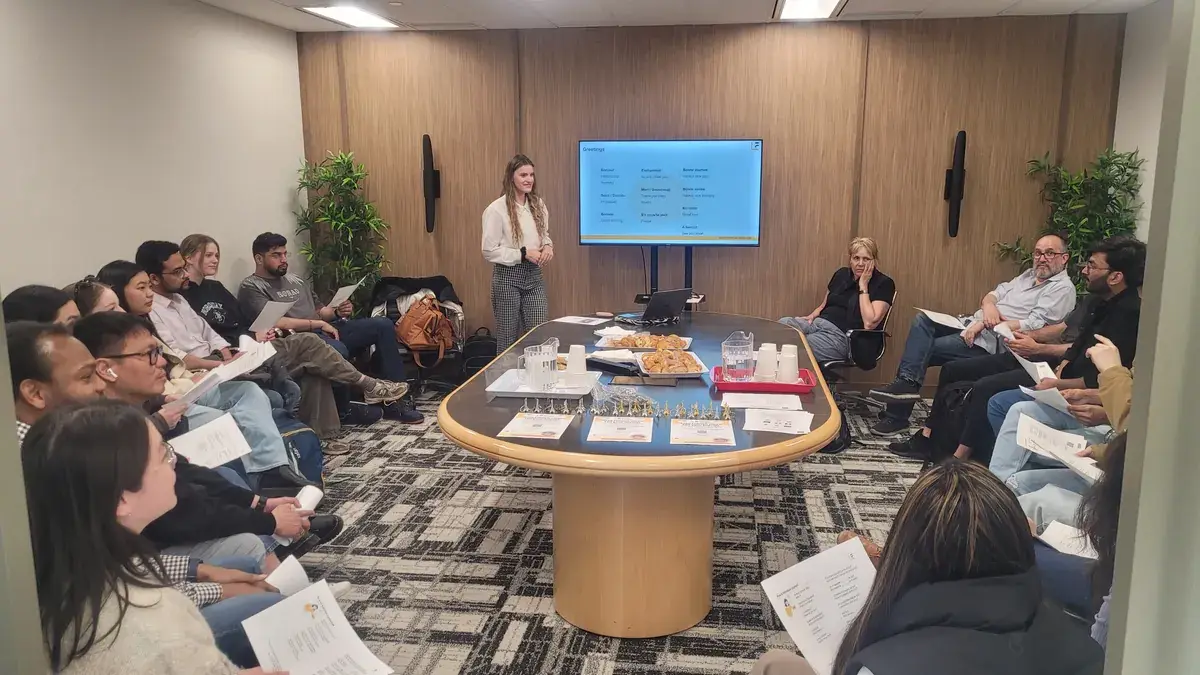
The 12-month program follows the plan above: Levels 1 to 6, then TEF/TCF preparation with mock exams and practice for every section. Your teacher corrects your homework, and each class has its own WhatsApp group where homework is shared.
"I'm a learner of online courses from level 1 to level 6. The entire program is professionally designed, both challenging and rewarding. Under the guidance of my charismatic teacher, Anne, it's truly possible to go from not being able to pronounce anything at the beginning to communicating confidently within six months. I was indeed a complete beginner with zero background knowledge."
Live classes aren't recorded, so class time is for speaking. Every plan includes 1 year of our online platform, with a self-study lesson on the same material if you miss a class.
Already have some French? The free French level test checks all four skills and tells you where to start.