

The TEF Canada exam is the French test that IRCC accepts, alongside the TCF Canada, as proof of French for Express Entry and permanent residence. It has four compulsory tests (reading, listening, writing and speaking), all taken on the same day, and each one gives you a level from NCLC 1 to 12.
The two most expensive mistakes have nothing to do with French. People book too late, or they copy the wrong column of their results into their Express Entry profile. Both are easy to avoid once you know where they hide.
What is the TEF Canada exam, and who needs it?
The TEF Canada is a French test for adults who need to prove their level to the Government of Canada. IRCC lists it as one of two approved French tests for Express Entry. The other one is the TCF Canada.
TEF stands for Test d'évaluation de français (French assessment test). Le français des affaires is the organization that owns the test and approves the centres that run it.
People usually sit it for one of three reasons:
- Express Entry with French as your first official language, where French is your main language result
- Express Entry with French as a second official language, to add CRS points on top of an English test
- Canadian citizenship, which needs only listening and speaking, at NCLC 4 or higher
Learn French Canada was founded in Vancouver in 2017 by Lea, a native French speaker from Tours, and has prepared 4,500+ students for the TEF and TCF Canada since then. Classes run online across Canada, with classrooms in Vancouver and in Calgary for Levels 1 to 3.
TEF Canada sections: format, timing and questions
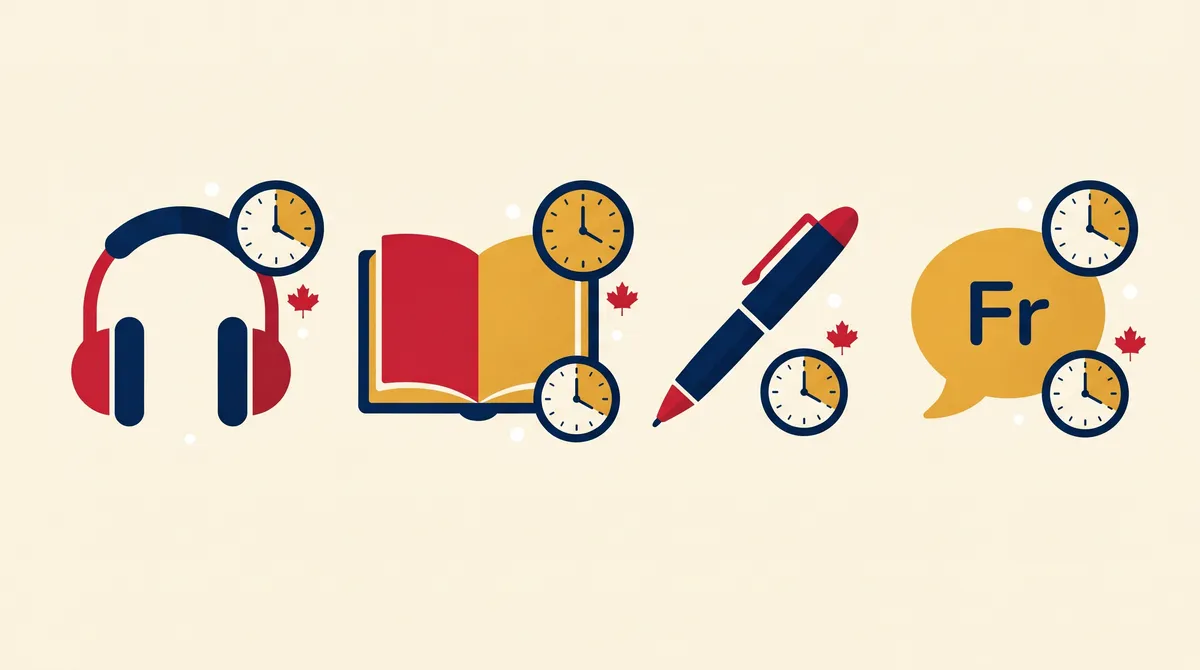
The TEF Canada has four tests and just under three hours of exam time: 40 reading questions in 60 minutes, 40 listening questions in 40 minutes, a 60-minute writing test and a 15-minute speaking test. Every approved centre follows this exact timing.
| Test | French name | Length | What you do |
|---|---|---|---|
| Reading | Compréhension écrite | 60 minutes | 40 multiple-choice questions |
| Listening | Compréhension orale | 40 minutes | 40 multiple-choice questions |
| Writing | Expression écrite | 60 minutes | Section A (25 min): continue an article, 80 words minimum. Section B (35 min): give and justify your opinion, 200 words minimum |
| Speaking | Expression orale | 15 minutes | Section A (5 min): ask questions to obtain information. Section B (10 min): argue to convince |
All four tests must be taken on the same day, or the Canadian authorities won't recognise your attestation. That adds up to 2 hours and 55 minutes of test time, so your stamina matters as much as your grammar.
Reading and listening: 80 multiple-choice questions
Both tests are multiple choice, with 40 questions each. Reading gives you a full hour. Listening gives you 40 minutes and moves at the pace of the recordings, which is what catches most people off guard.
What helps:
- Read the questions before the text or the audio, so you know what you're hunting for.
- Practise numbers out loud: soixante-dix (70), quatre-vingts (80), quatre-vingt-dix (90). They trip people up in prices, dates and phone numbers.
- Train with the real timing early, not only in the last week. The format stops being stressful once it's familiar.
Writing: two texts, two word counts
The writing test lasts 60 minutes in two parts. In Section A (25 minutes) you continue an article in at least 80 words. In Section B (35 minutes) you give your opinion on a topic and justify it in at least 200 words.
Section B carries the real time pressure: 200 words of argued French in 35 minutes. A handful of linking words, used on purpose, make your text much easier to follow:
- d'abord (first)
- ensuite (then)
- cependant (however)
- par contre (on the other hand)
- donc (so)
- enfin (finally)
Speaking: 15 minutes, two tasks
The speaking test lasts 15 minutes. In Section A (5 minutes) you ask questions to get information. In Section B (10 minutes) you try to convince the examiner of something.
Section B goes better with a clear four-step arc:
- Open: state your position. Je te conseille vraiment de... (I really advise you to...)
- Argue: give two concrete reasons. D'abord..., ensuite... (First..., then...)
- Handle pushback: answer the objection calmly. Je comprends, mais... (I understand, but...)
- Close: sum up and ask for agreement. Alors, tu es convaincu\u00a0? (So, are you convinced?)
Speaking and writing usually move slower than listening and reading. Give them the biggest share of your study time from the start, not in the final month.
How TEF Canada scoring works
Each of the four tests gets its own result on your attestation: a TEF score from 0 to 699, a CEFR level from A1 to C2 and an NCLC level from 1 to 12. There's no single overall grade, and IRCC checks every skill against its own minimum.
In reading and listening, your raw count is not your final score. The examiners convert right answers into a calibrated grade, so scoring 31 out of 40 does not translate into a simple percentage or an obvious NCLC band.
| Test | How it's marked |
|---|---|
| Reading | Right answers converted into a calibrated score |
| Listening | Right answers converted into a calibrated score |
| Writing | Two independent examiners |
| Speaking | The centre's facilitator, plus a second evaluator who works from the recording |
On practice tests, treat any raw count as a rough guide only. For writing and speaking, check yourself against the task: did you reach 80 and 200 words, and did you answer exactly what was asked?
Which TEF Canada score goes in your Express Entry profile?
Only the numbers from the "Équivalence ancien score" column go into Express Entry. IRCC says the "Score / 699" column is not compatible with its system, and you must not enter those results in your profile.
The rule, with the score range for every NCLC level, sits on IRCC's Express Entry language test page (opens in a new tab), updated in 2026. It's worth reading before you fill in a single box.
Here are IRCC's old-score ranges for the two levels most programs ask for:
| Level (IRCC, 2026) | Speaking | Listening | Reading | Writing |
|---|---|---|---|---|
| NCLC 7 | 310-348 | 249-279 | 207-232 | 310-348 |
| NCLC 5 | 226-270 | 181-216 | 151-180 | 226-270 |
Look closely and you'll see the same number means different things in different skills. A 215 is NCLC 7 in reading but below NCLC 5 in writing. Never compare your skills by the raw number alone.
Worked example
Say your attestation shows these results in the old-score column:
| Skill | Your old score | NCLC 7 range | NCLC 7 reached? |
|---|---|---|---|
| Speaking | 330 | 310-348 | Yes |
| Listening | 262 | 249-279 | Yes |
| Reading | 215 | 207-232 | Yes |
| Writing | 295 | 310-348 | No |
Three skills reach NCLC 7 and writing sits just below the range. For a Federal Skilled Worker profile with French as your first official language, that one skill means you don't meet the minimum yet.
The fix is focused: retrain writing hard, keep the other three warm with lighter practice, and sit all four tests again on one day. To check every part of the document, read how to read your TEF Canada results.
Every level's range, side by side, is in our TEF Canada score requirements and CLB conversion guide.
What NCLC level does your immigration program need?
Federal Skilled Worker candidates with French as their first official language need NCLC 7 in all four skills. Other programs ask for less, and IRCC sets each minimum skill by skill, so one weak skill can hold back a strong overall result.

| Program | Minimum level in French (2026) |
|---|---|
| Federal Skilled Worker, French as first official language | NCLC 7 in all 4 skills |
| Federal Skilled Worker, French as second official language | NCLC 5 minimum |
| Canadian Experience Class, TEER 0 or 1 job | NCLC 7 |
| Canadian Experience Class, TEER 2 or 3 job | NCLC 5 |
| Federal Skilled Trades | NCLC 5 in speaking and listening, NCLC 4 in reading and writing |
| Canadian citizenship | NCLC 4 in listening and speaking (2 tests only) |
IRCC's Express Entry language page sets the immigration minimums in the table. The citizenship line comes from Le français des affaires, which also confirms that citizenship candidates take only the listening and speaking tests.
Above the minimum, strong French adds points. In 2026, NCLC 7 or higher in French is worth up to 50 extra CRS points for an Express Entry candidate: 25 or 50, depending on your English results.
In the Federal Skilled Worker grid, a first-language result of NCLC 9 or higher earns the maximum of 6 points per ability, up to 24 points. NCLC 7 is still the level to aim for first. It's the minimum, and it's where the French points start.
How to book the TEF Canada exam
You book the TEF Canada directly with an approved test centre, not through IRCC. Each centre sets its own fee, and the price also depends on how many tests you take, so there's no single national price to compare against.
- Confirm the NCLC level your program needs, skill by skill.
- Pick a target date that leaves room for a retake before your deadline.
- Find an approved centre on the Le français des affaires registration page.
- Ask the centre what it charges for the tests you need.
- Register for all four tests on one day for immigration, or listening and speaking for citizenship.
A registration is firm and final. Miss the exam without a valid reason and you lose the fee. With a justified absence, you may get a free re-registration, so contact the centre as soon as you know you can't attend.
For the day itself, from check-in to the last speaking task, see TEF exam day: what to expect.
Results, validity and appeals
TEF Canada results arrive about 2 weeks after the test, according to Le français des affaires. Your attestation is valid for 2 years from its issue date, and IRCC needs it to be less than 2 years old at two separate moments:
- when you complete your Express Entry profile
- when you submit your permanent residence application
IRCC is direct about the second point: apply for permanent residence with expired results and your application will be refused. The risk is real if you test early and then spend a long time in the Express Entry pool.
| What | Rule | Who sets it |
|---|---|---|
| Results | About 2 weeks after the test | Le français des affaires |
| Validity | 2 years from the issue date | Le français des affaires |
| Express Entry | Under 2 years old at profile and at PR application | IRCC |
| Appeal | Within 30 days of the attestation date | Le français des affaires |
Appeals: 30 days, and only for problems on the day
You can appeal within 30 days of the date on your attestation. The test board only reviews complaints about real test-day incidents, such as a frozen screen or broken headphones, and you have to report the problem to your invigilator right then.
So if the audio cuts out during listening, speak up before you leave the room. An appeal because you hoped for a higher score won't meet that rule.
How long does it take to prepare for the TEF Canada?
From zero French, plan on 12 months to reach NCLC 7: six months of foundations, then six months of TEF/TCF preparation. With a B1 base, six months of exam preparation is a realistic target for NCLC 7, and three months for NCLC 5.
| Starting point | Target | Time | Path |
|---|---|---|---|
| Zero French | NCLC 4/5 | 6 months | Levels 1 to 6 |
| Zero French | NCLC 5 | 6 to 9 months | Levels 1 to 6, plus up to 3 months of exam prep |
| Zero French | NCLC 7 | 12 months | 6 months of foundations, then 6 months of exam prep |
| B1 or higher | NCLC 5 | 3 months | TEF/TCF exam prep |
| B1 or higher | NCLC 7 | 6 months | TEF/TCF exam prep |
Those timelines assume live classes plus daily practice at home. Twenty minutes of French every day keeps what you learn in class alive, and reading a paragraph aloud builds the habit of answering without translating in your head.
Nobody gets from zero to NCLC 7 in a few weeks, whatever an ad says. For the reasoning behind each timeline, read how long it takes to learn French for Canadian PR.
TEF Canada or TCF Canada: which should you take?
Both tests are approved by IRCC for Express Entry and both report an NCLC level for each skill, so either one can carry your French result. The better choice is the one whose format suits you and whose dates fit your deadline.
To decide between the two, check what matters in your city and on your calendar:
- which test has a centre and a date near you before your deadline
- which reading and listening format you feel more at ease with
- how much time you have to prepare for one specific format
Compare the two in TEF vs TCF: which French exam to choose. For the other test's own format, scores and booking, see our guide to the TCF Canada.
How we help you prepare
The right program depends on where you start. From zero French, the 12-month TEF Beginner path targets NCLC 7. With a B1 base, TEF Intermediate targets NCLC 5 in three months or NCLC 7 in six.
In our classes, you meet twice a week for 90 minutes, live, with at most 14 students, so everyone speaks in every class. After Levels 1 to 6 comes TEF/TCF preparation with mock exams and practice for every section of the exam.
- Homework corrected by your teacher, shared in your class's own WhatsApp group
- Mock exams in the real format and the real timing
- One year of our online platform: recorded lessons, worksheets, quizzes and homework
- Live classes aren't recorded, so class time goes to speaking; miss one and the platform has a self-study lesson on the same material
- Private sessions on top, if you want extra speaking practice
Already around B1 with a test date coming? The TEF Intermediate course for B1 learners works through reading, listening, writing and speaking one section at a time, with mock exams scored by teachers who know the marking grid.
"I'm having a great experience learning French with Camille! She is patient, knowledgeable, and explains concepts very clearly. Her TEF/TCF preparation is helpful and boosted my confidence. I recommend her to anyone serious about learning French!"